 Accessibility Information
About
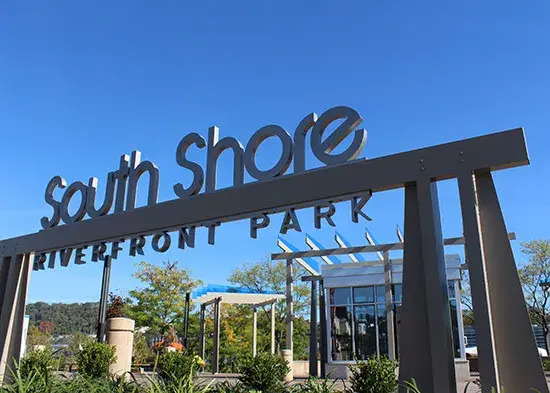
South Shore Riverfront Park and Trail runs along the Monongahela River at SouthSide Works, between 25th Street and Hot Metal Street in Pittsburgh's South Side. The site was once the J&L Steel Works, and the former steel mill barge dock was converted into roughly 3.2 to 3.4 acres of public open space that opened in 2012 at a cost of about $13 million. The design straddles a railroad tunnel and overcomes a 40 foot drop in elevation to reach the river, with switchback terraces connecting the upper and lower plazas. The park carries both the Three Rivers Heritage Trail and the multi-state Great Allegheny Passage, and its cycling and pedestrian trail is split into an upper section beside the SouthSide Works development and a lower section at water level. Features include a piazza that acts as the park's front door, a 1,000 seat amphitheater and event stage under a tensile canopy, scenic overlooks, a river landing, a public boat dock open since October 2013, the adjacent South Side Marina from 2015, a water fountain for dogs, a mister for cooling trail users, and public art including The Workers, a steelworker monument built from Hot Metal Bridge I-beams. The park is owned by the Urban Redevelopment Authority of Pittsburgh and managed by the Soffer Organization, so it is not run by Citiparks even though the City lists it among its parks.
Getting To and From
Inside the Venue
Location
Getting To and From
Find essential details on parking, drop-off points, and accessibility to make your visit smooth and hassle-free.
Check the table below for more information.
Check the table below for more information.
Inside the Venue
Get to know what to expect indoors—from seating layouts to restrooms and concessions.
Onsite Accessibility
Learn about ramps, elevators, restrooms, and other accessible features available during your visit
Our Guidelines
1. Make Accessibility Info Easy to Find - Dedicated Website Accessibility Page
Clearly post detailed accessibility information online, covering parking, entrances, interior pathways, site plans, and more.
2. Include All Mobility Devices
Consider walkers, canes, crutches — not just wheelchairs. Provide specifics for a variety of mobility needs. Include people who use different devices in the conversation.
3. Go Beyond ADA Compliance
ADA is the minimum. Strive for real-world accessibility through thoughtful design and ongoing improvements.
4. Visibility = Accessibility
If disabled visitors aren't present, barriers may exist. Transparency and preparation are the keys to inclusion. Empower everyone to attend.
Latest Places
Oct 14 2026
Sep 30 2026
Sep 30 2026

Leave Your Comment Here