 Accessibility Information
About
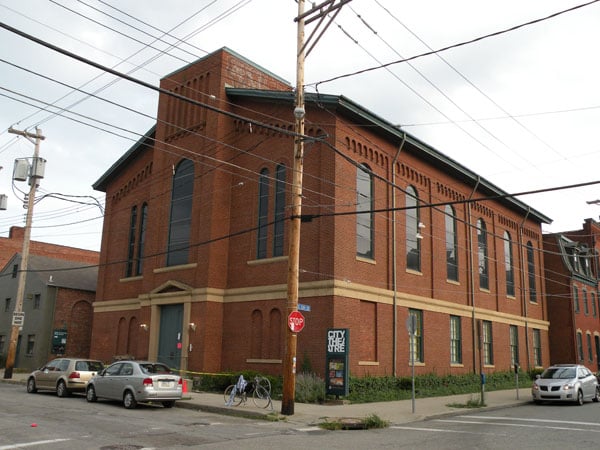
City Theatre Company is an independent theater company on Pittsburgh's South Side, describing itself as a four-building cultural campus. It runs two performance spaces, and the site gives both the same address of 1300 Bingham Street in its own event data: the Mainstage, which has reserved seating and two published configurations called Proscenium and Thrust, and the Lillie Theatre, which is entirely general admission. The company states that parking, curbside assistance upon request, accessible entrances, accessible seating, accessible restrooms and an elevator are available at both of its venues, and that assistive listening devices are available at both. It provides its own patron parking for $10 in a lot at 1317 Bingham Street, across from the theatre entrance.
The detail stops there for the Lillie, but the Mainstage has one unusually helpful document: an official social story that walks through the route, describing entry through the big red doors into a gray hallway with the box office at the end, a large lobby with a concession stand, two large bathrooms plus a private accessible bathroom, an auditorium upstairs, and an elevator across from the staircase with button 2 for the theater level. None of that detail is published for the Lillie Theatre, so do not assume it carries across.
Getting To and From
Inside the Venue
Getting To and From
Find essential details on parking, drop-off points, and accessibility to make your visit smooth and hassle-free.
Check the table below for more information.
Check the table below for more information.
Inside the Venue
Get to know what to expect indoors—from seating layouts to restrooms and concessions.
Onsite Accessibility
Learn about ramps, elevators, restrooms, and other accessible features available during your visit
Our Guidelines
1. Make Accessibility Info Easy to Find - Dedicated Website Accessibility Page
Clearly post detailed accessibility information online, covering parking, entrances, interior pathways, site plans, and more.
2. Include All Mobility Devices
Consider walkers, canes, crutches — not just wheelchairs. Provide specifics for a variety of mobility needs. Include people who use different devices in the conversation.
3. Go Beyond ADA Compliance
ADA is the minimum. Strive for real-world accessibility through thoughtful design and ongoing improvements.
4. Visibility = Accessibility
If disabled visitors aren't present, barriers may exist. Transparency and preparation are the keys to inclusion. Empower everyone to attend.
Latest Places
Sep 16 2026

Sep 16 2026
Sep 16 2026

Leave Your Comment Here